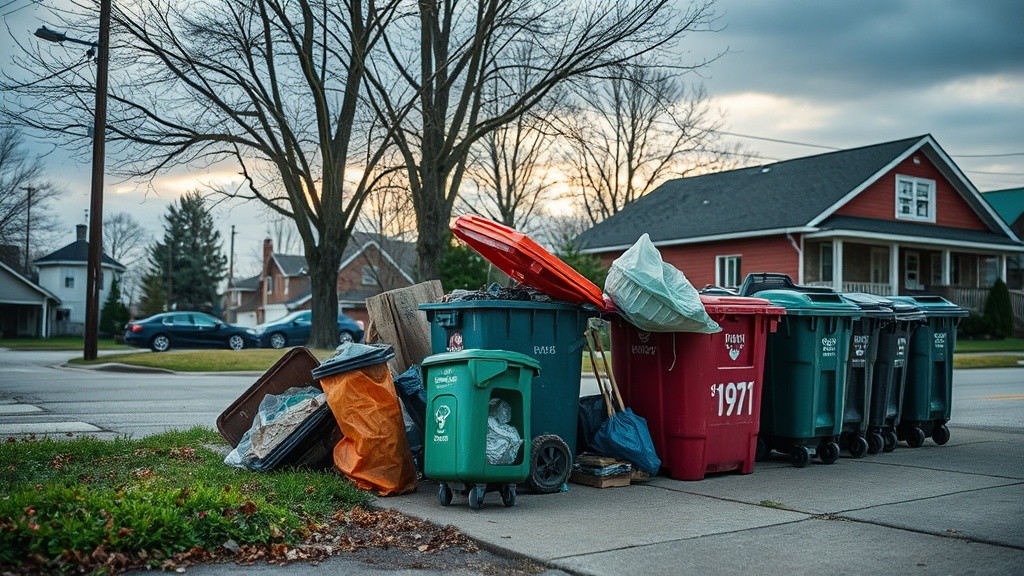
The St. Catharines Curbside Cheat Sheet for Garbage, Recycling, and Yard Waste

This guide lays out how curbside pickup works in St. Catharines right now: when to put items out, what belongs in each stream, what needs a booking, and which problem items belong at a depot instead of by the sidewalk. If you've ever stood in the driveway holding a dead battery in one hand and a takeout container in the other, this is the version that keeps the guesswork out of garbage day.
What day is garbage and recycling pickup in St. Catharines?
The only reliable answer is your exact address. Niagara Region runs curbside collection, and the official collection schedule lookup tells you your pickup day, service notes, large-item booking options, and whether any limits or exceptions apply to your property. Put everything out by 7 a.m. on collection day. You can place items out after 5 p.m. the evening before, but earlier than that is asking for ripped bags, raccoons, and a sidewalk nobody enjoys looking at.
There are a few details worth knowing before you rely on memory. Garbage is not weekly for most houses, and some mixed-use or business-area properties can follow different rules than a typical single-family home. Niagara Region also pushes reminders through the waste app, which is worth using if your week already has enough moving parts. Since Niagara's Blue Box program fully transitioned on January 1, 2026, recycling questions now run through Circular Materials' Niagara page and Miller Waste for missed collection or replacement boxes.
What goes out every week, and what only goes every other week?
Here's the plain-English version most households need. Weekly pickup covers the stuff that gets messy fast; every-other-week pickup covers the stuff you should be shrinking anyway. Once you know that split, the whole system makes a lot more sense.
| Stream | Typical frequency | What to remember |
|---|---|---|
| Blue Box | Weekly | Container packaging like glass, cans, plastics, cartons, and foam food containers. |
| Grey Box | Weekly | Paper and fibre like cardboard, boxboard, paper, and bundled plastic bags. |
| Green Bin | Weekly | Food scraps, food-soiled paper, egg cartons, and other accepted organics. |
| Yard Waste | Weekly, year-round | Leaves, plants, weeds, and hedge trimmings; grass clippings stay out. |
| Garbage | Every other week | Usually limited to two bags or cans unless you buy extra garbage tags. |
| Large Items | Booked pickup | Book at least two working days before your regular collection day. |
The part people forget is that yard waste is collected weekly year-round for single-family homes and small apartment buildings, while garbage is collected every other week with a two-bag or two-can limit for most residents. That one detail changes how you should sort the kitchen bin. If food scraps, paper towels, and pet waste are still going into the garbage, you're basically choosing to store smell for an extra week.
If something is organic, recyclable, or reusable in another stream, get it out of the garbage bag before you tie it shut.
What belongs in the blue box, grey box, and green bin now?
Niagara still uses the familiar blue-and-grey split, but the accepted items changed enough that old habits can trip you up. According to the 2026 recycling guide, the Blue Box is for containers: plastics, glass containers, metal cans and lids, cartons, foam food containers, and other packaging that held something. The Grey Box is for fibre: paper, boxboard, cardboard, and bundled plastic bags. Think of it as containers in blue, paper in grey.
A few rules matter more than the rest. Containers should be empty; many should get a quick rinse; cardboard should be flattened; and oversized cardboard needs to stay within the Region's listed size limit. Shredded paper should be tied inside a clear plastic bag. Books, toys, diapers, batteries, and pots and pans do not belong in curbside recycling, even if they look like they ought to. That yellow oops sticker shows up when the collector spots the wrong material, and then you're the person dragging the same box back in.
The Green Bin is where St. Catharines households can win back a lot of space. Niagara says it accepts food scraps, bones, meat, dairy, food-soiled paper, paper egg cartons, and even pet waste or kitty litter when it's wrapped the right way. That surprises people every year. A backyard composter is fine for peels and garden scraps, but it doesn't replace the Green Bin for all the messier stuff. If your garbage still feels full after sorting organics properly, something is still landing in the wrong place.
- Blue Box: bottles, jars, plastic tubs, metal cans, cartons, foam trays, clean aluminum trays and foil.
- Grey Box: newspapers, flyers, office paper, cereal boxes, shipping boxes, flattened cardboard, bundled plastic bags.
- Green Bin: food waste, coffee grounds, meat and bones, dairy, paper towels, napkins, egg cartons, pet waste, small amounts of yard waste.
- Not curbside recycling: batteries, paint, toys, books, broken light bulbs, loose bagged garbage, and anything still half full of liquid.
When you hit an edge case — an aerosol can, a black plastic tray, or a stack of delivery boxes after a busy week — the 2026 Niagara recycling guide is more useful than neighbourhood folklore.
Where do paint, batteries, and chemicals go in St. Catharines?
Not at the curb. Niagara Region's household hazardous waste depots take the items that can cause real trouble in a truck or at a sorting line: paint, solvents, pesticides, gasoline, propane tanks, car batteries, cleaning products, fluorescent bulbs, and full or partly full aerosol cans. Depots operate year-round, and St. Catharines residents usually end up using the Thorold or Welland options because they're the least annoying drive.
There are rules attached. Niagara says residents should bring materials in original or clearly marked containers, keep containers sealed, and stay within the daily liquid limits. Fort Erie's Bridge Street site only accepts a shorter list — batteries, oil, propane tanks, and paint — so don't pack the trunk and assume every depot takes everything.
One more local habit worth dropping: don't stash this stuff in the basement until you have a mountain of it. Paint hardens, labels fall off, and mystery jugs become harder to deal with later. If you've already got one shelf of old chemicals, do a depot run once and reset the whole situation.
What about furniture, branches, and the weird stuff?
Large items are collected, but they aren't a magic curbside free-for-all. Niagara Region says you need to book large-item pickup at least two working days in advance of your regular collection day. That's the route for furniture, bulky plastic items, carpet, and some small appliances. If you just drag a couch to the curb without booking it, you're mostly decorating the street.
Branches are a separate seasonal service collected for four weeks in spring and four weeks in fall. Yard waste itself is easier: leaves, weeds, hedge trimmings, and plants can go out weekly year-round, but grass clippings are not accepted in yard waste collection. Twigs and clippings have size limits too — Niagara lists a maximum of 1.5 cm in diameter and 30.5 cm in length. That sounds picky until you picture the machinery on the other end.
For the stuff that doesn't fit a category, use Niagara's item disposal search before collection day. It's the fastest way to figure out whether something belongs in a depot, a donation stream, a booked pickup, or nowhere near the curb. Renovation leftovers are where people get this wrong most often; drywall, concrete, and other construction material don't belong in the regular curbside flow just because they came from your own house.
How do you avoid missed pickup and those yellow oops stickers?
Make the system easy on yourself. Keep one mental rule for each stream, not twenty. Blue is containers. Grey is fibre. Green is anything organic or food-soiled that Niagara accepts. Garbage is the leftovers after you've made those calls. Put a screenshot of your address schedule on your phone, keep a small box in the garage for batteries and bulbs, and flatten cardboard as it comes in instead of building a tower by the back door.
That last part matters more than people think. Most curbside problems in St. Catharines don't come from hard rules; they come from leaving decisions until 6:45 a.m. (which is when everything suddenly looks recyclable). Check the schedule or item guide before you roll anything out, then send the right thing to the curb once.